Precision Tools for Shoulder Arthroplasty
Redesigned Arthrex's pre-operative planning s oftware, cutting planning-to-operation time 35–52% and reducing surgical error margins with a VR-based planning tool.
MedTech
Robotics
Pre-operative Planning Software
Human Factors
UX

Arthrex
About This Project
The Challenge
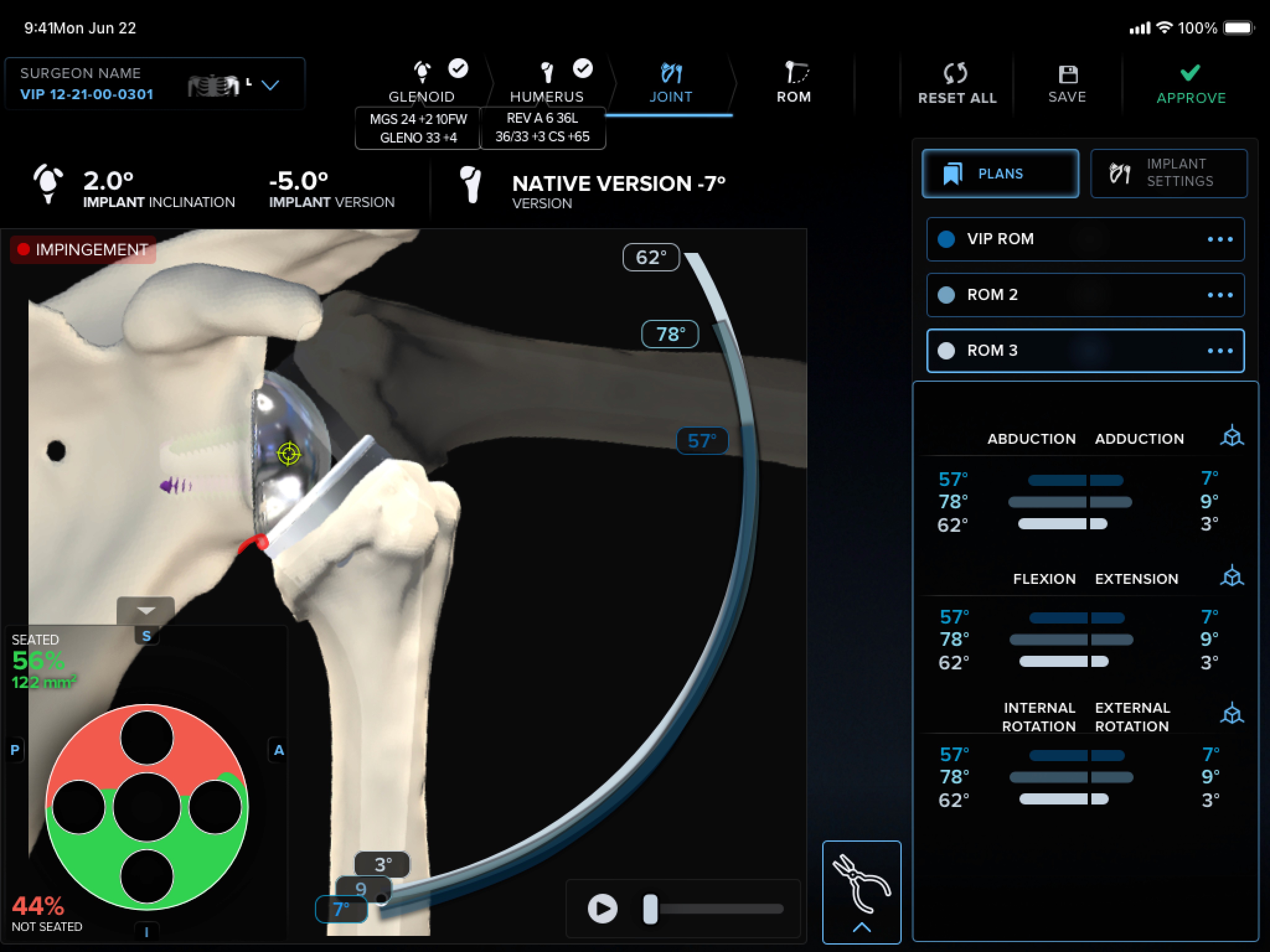
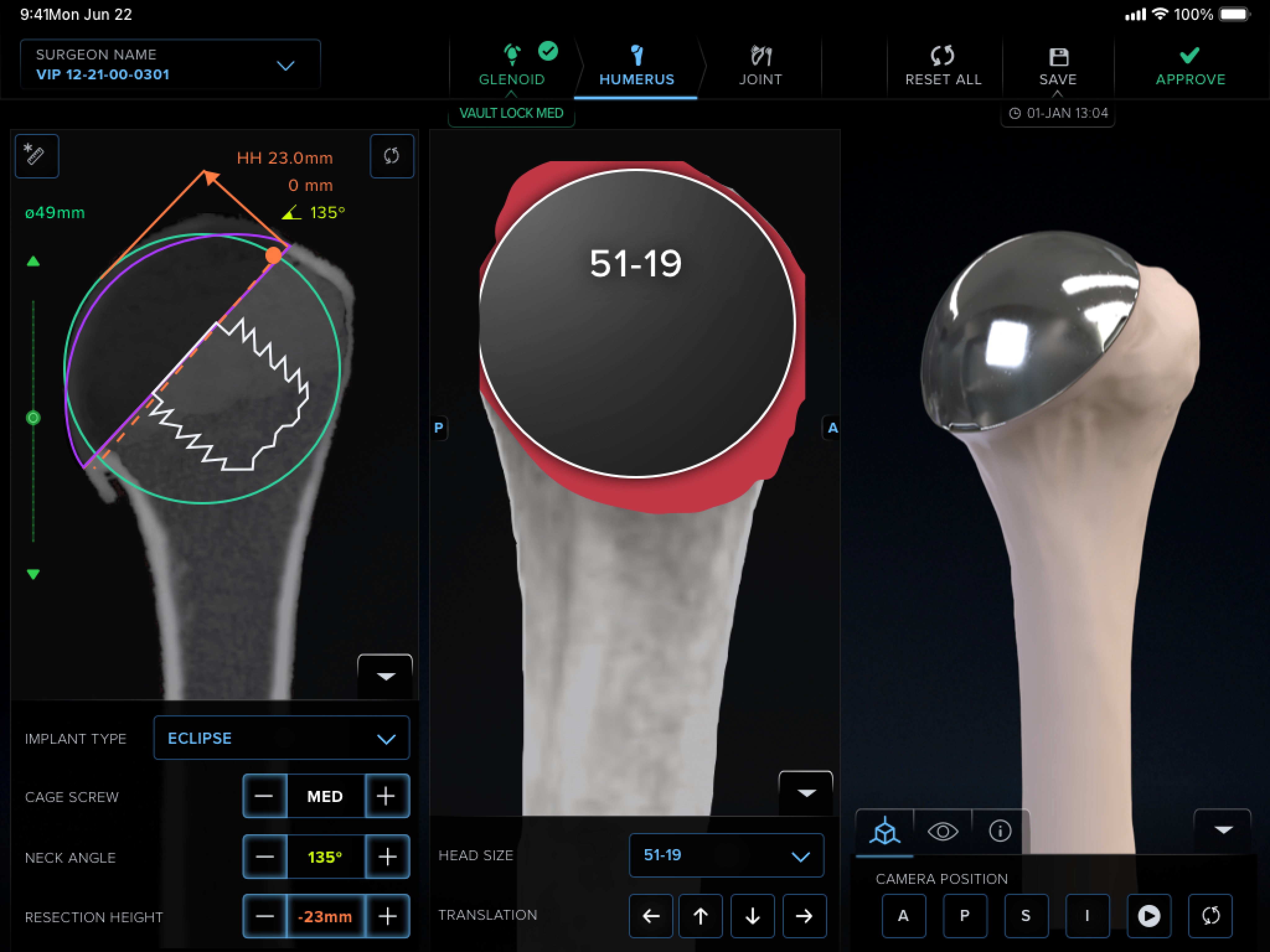
In total shoulder arthroplasty, outcome comes down to one thing more than almost anything else: how well the implant is positioned. Positioning is what determines a patient's post-op range of motion, and whether the surgeon runs into a bony impingement mid-procedure they didn't see coming. Before this project, surgeons had limited ability to see or compare that outcome ahead of time, they were largely deciding on positioning once they were already in the OR. Arthrex wanted software that could take a patient's own CT scan, build it into a 3D model, and let the surgeon simulate and compare implant positions against it, checking for range of motion and impingement risk, before making a single cut.
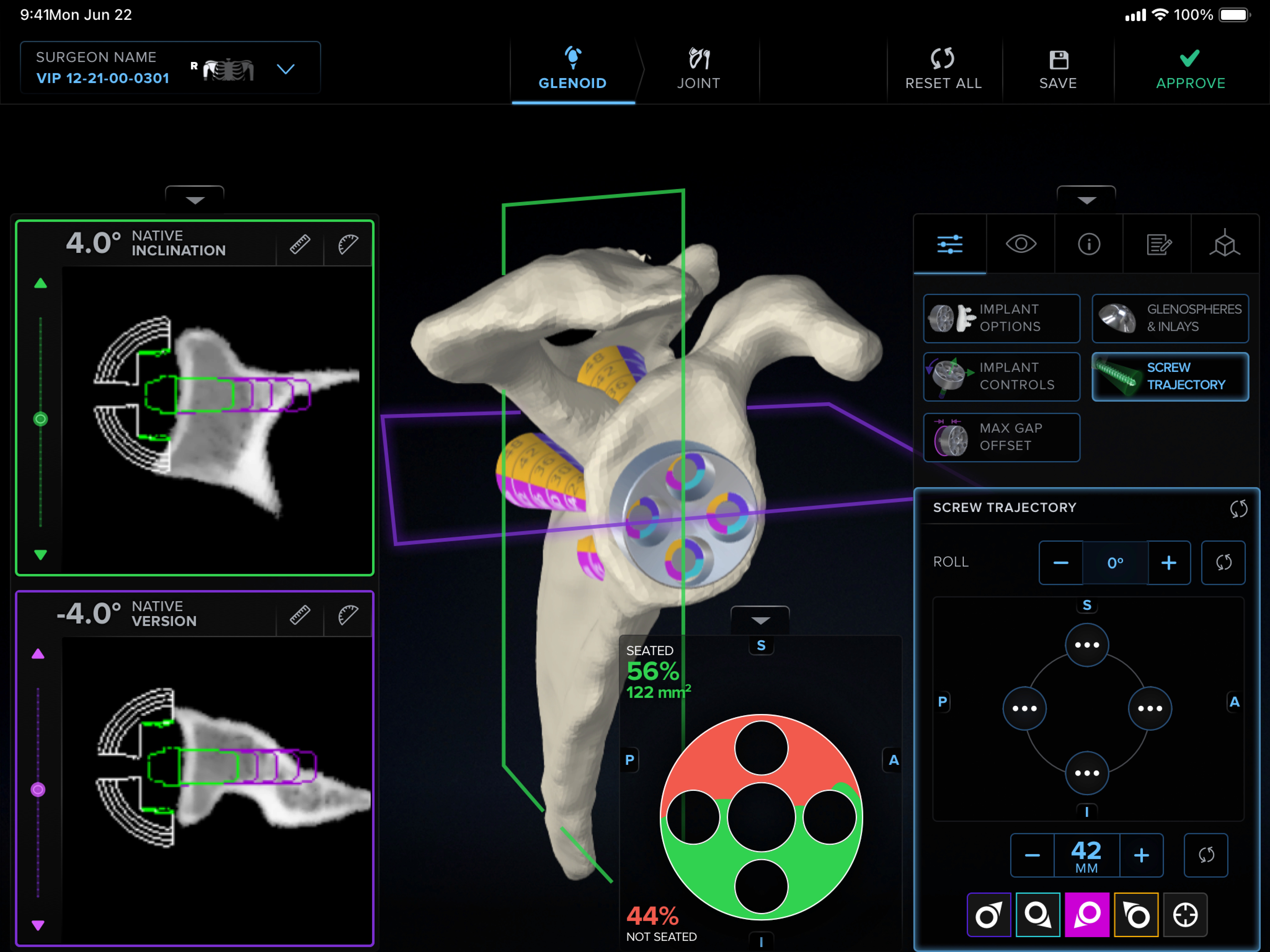
There was a second layer once the surgeon was actually in the room: whatever was planned had to hold up on embedded hardware with limited pixels and a restricted color palette, where color choices carry real clinical meaning and can't be treated like ordinary interface decisions.
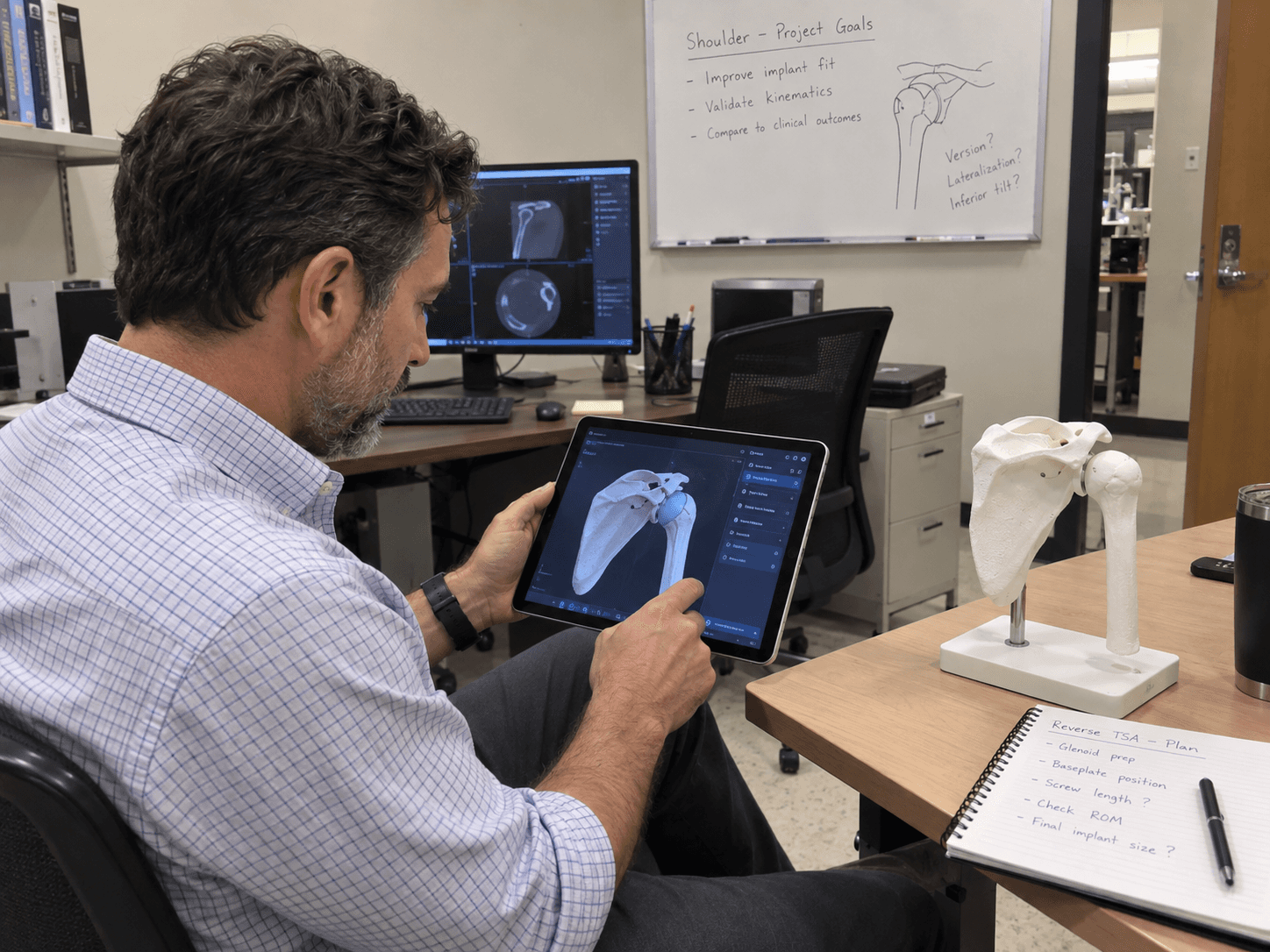
This is one of Arthrex's highest-value product lines, and one of the most common shoulder surgeries performed by clients.
How I Approached It
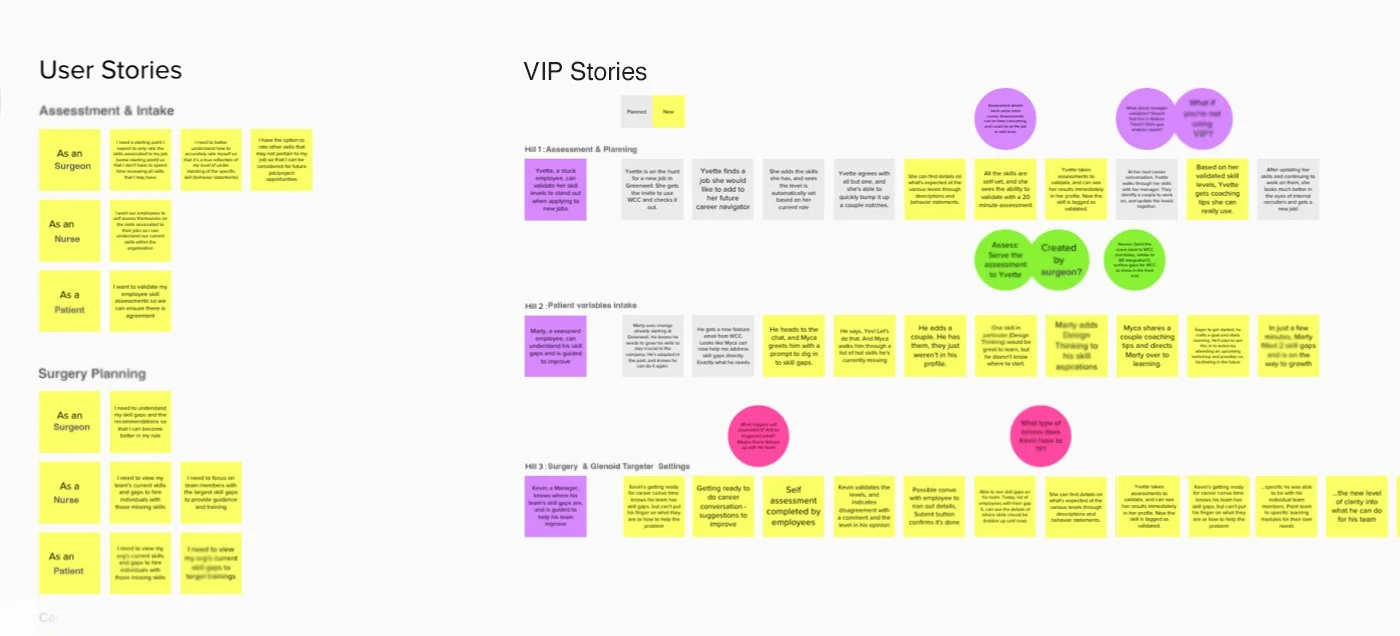
I owned this from the start, research, design direction, and workshop facilitation. There was no traditional product team. The closest thing to product owners were sales reps, who doubled as the surgeons' main point of contact and knew the clinical side of this product better than most of the company did. My actual collaborators were industrial design engineers, a 3D engineering team, robotics engineers, a human factors researcher, QA, and engineering, plus a cadaver lab, where we got real anatomical parts, 3D printed them, and tested the planning software's predictions against reality.
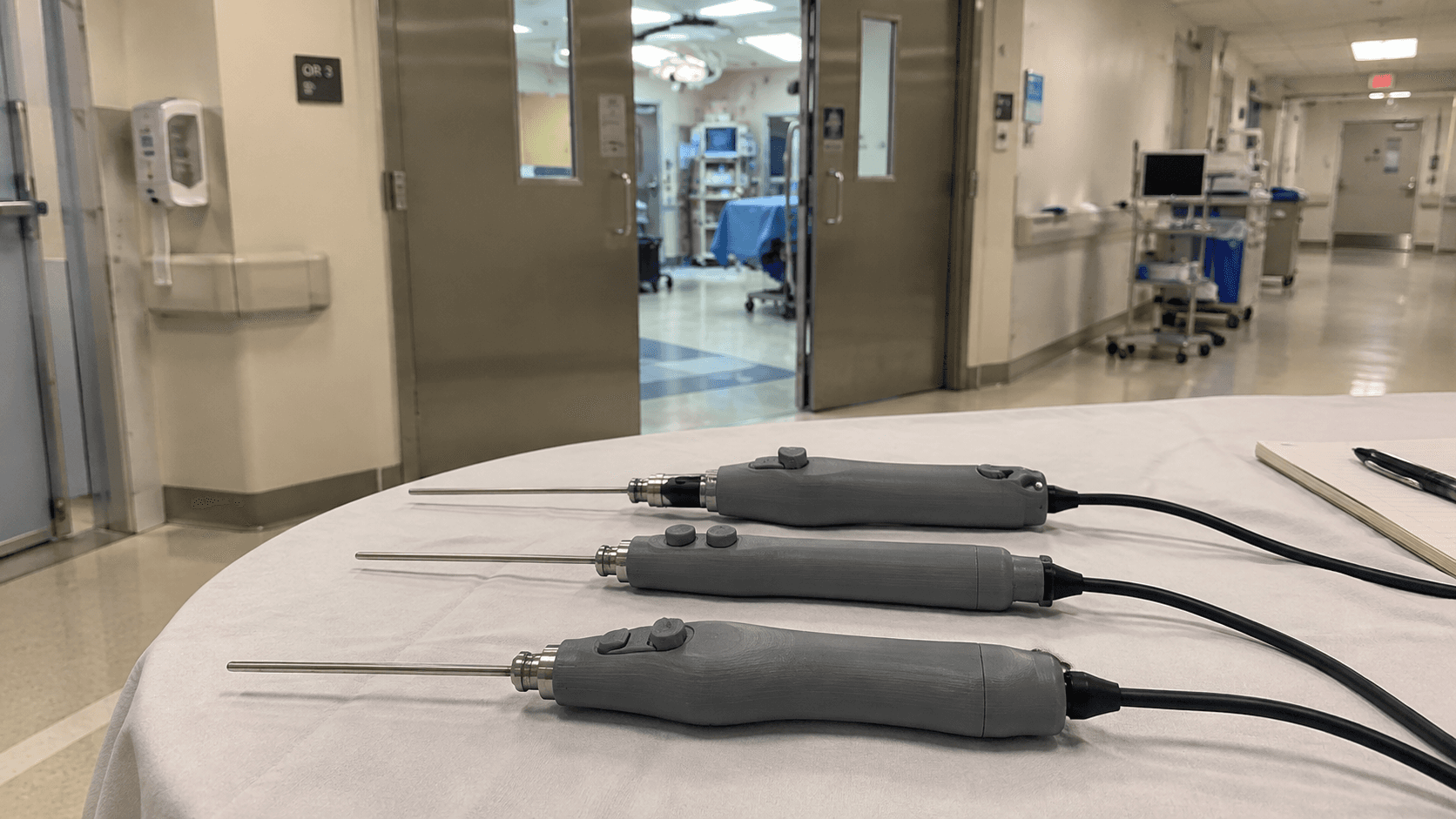
I ran a formative assessment to see how surgeons actually understood the system mid-decision, mid-surgery. That surfaced things a typical UX study wouldn't: how far apart devices needed to sit for readability, what audio patterns worked given limited audio capability, what haptic feedback needed to feel like in a remote a surgeon can't look down at. I shaped the physical design of the handles and remotes for the robotics hardware itself, this wasn't a screen-only project. Testing happened between live surgeries at surgery centers, pop-ups where surgeons tried device variations in the gaps between procedures.
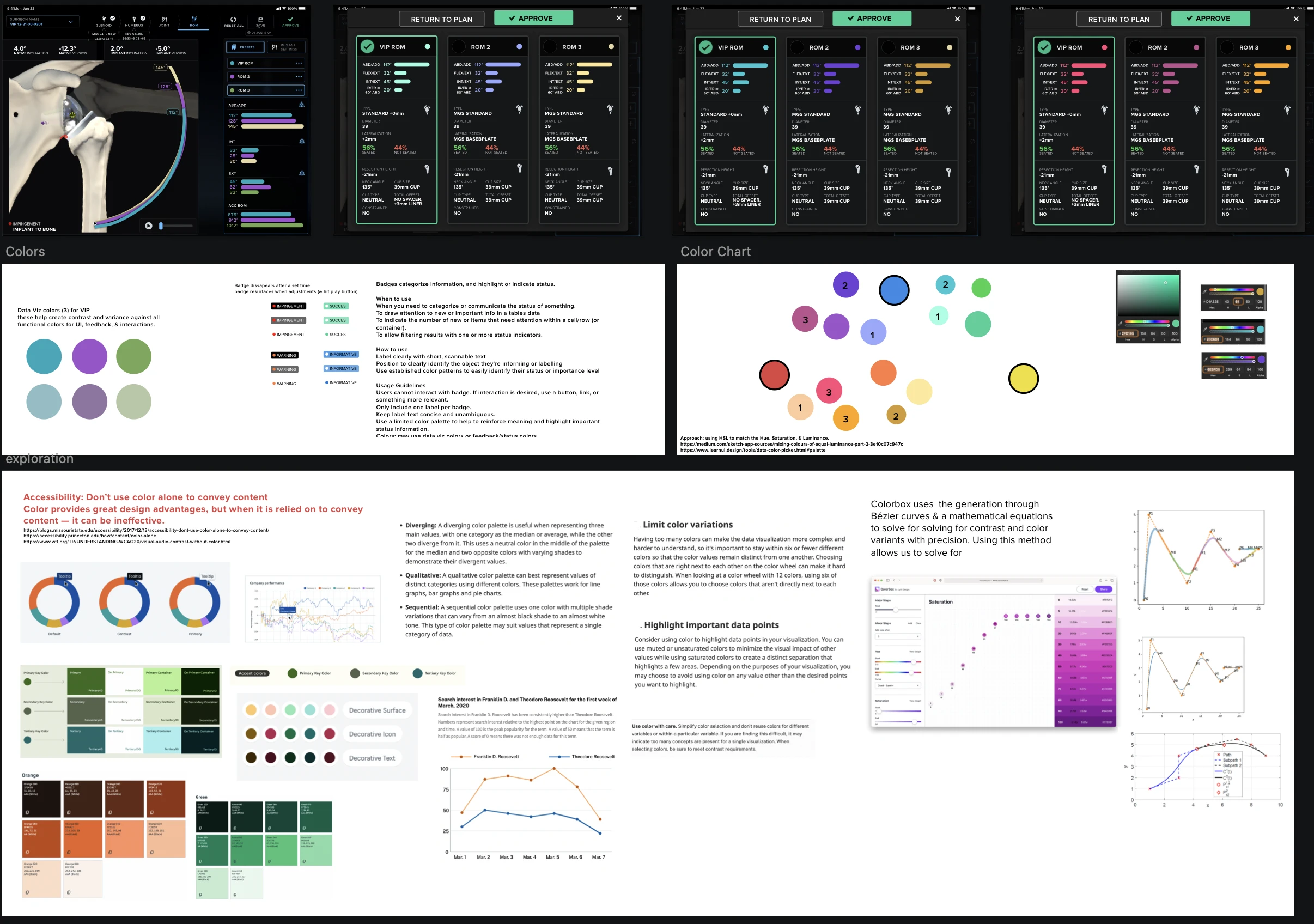
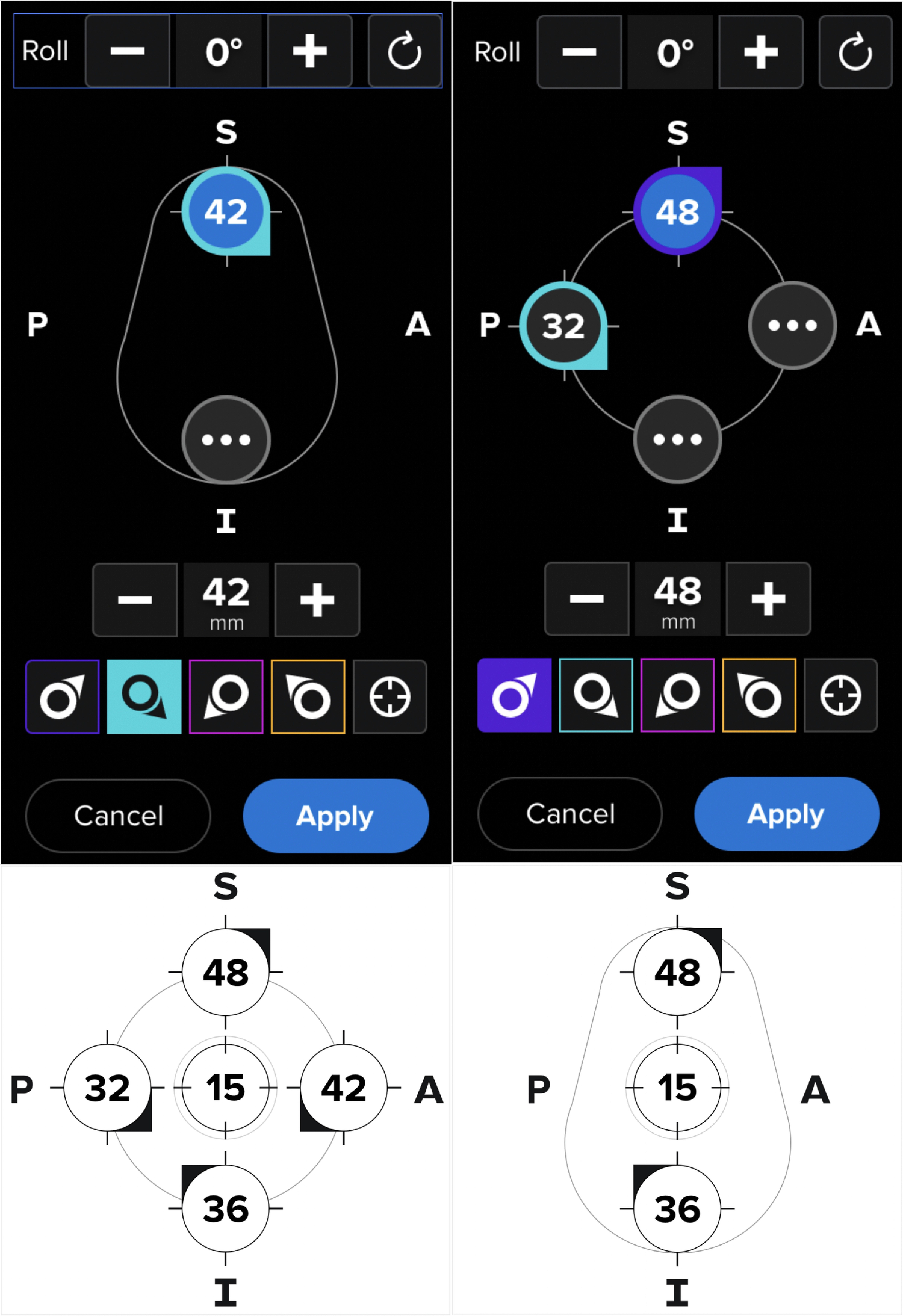
The color and badge system became the production design language across each surface: embedded hardware, iPad, desktop, and mobile. It solved a measured problem, misreads and confusion between visually similar elements, the kind of error that matters more in an operating room than almost anywhere else.
What We Built
The core product was Virtual Implant Positioning, a web and iPad app for surgical planning, plus a separate mobile companion for screw trajectory, plus custom embedded software running on the hardware itself. I designed the interface layer across it all, defining controls in the challenge it talks about how you know because we are very different visuals but you can't good version?, how they were labeled, the icon language, the color logic, consistent from the screen down to the physical hardware.
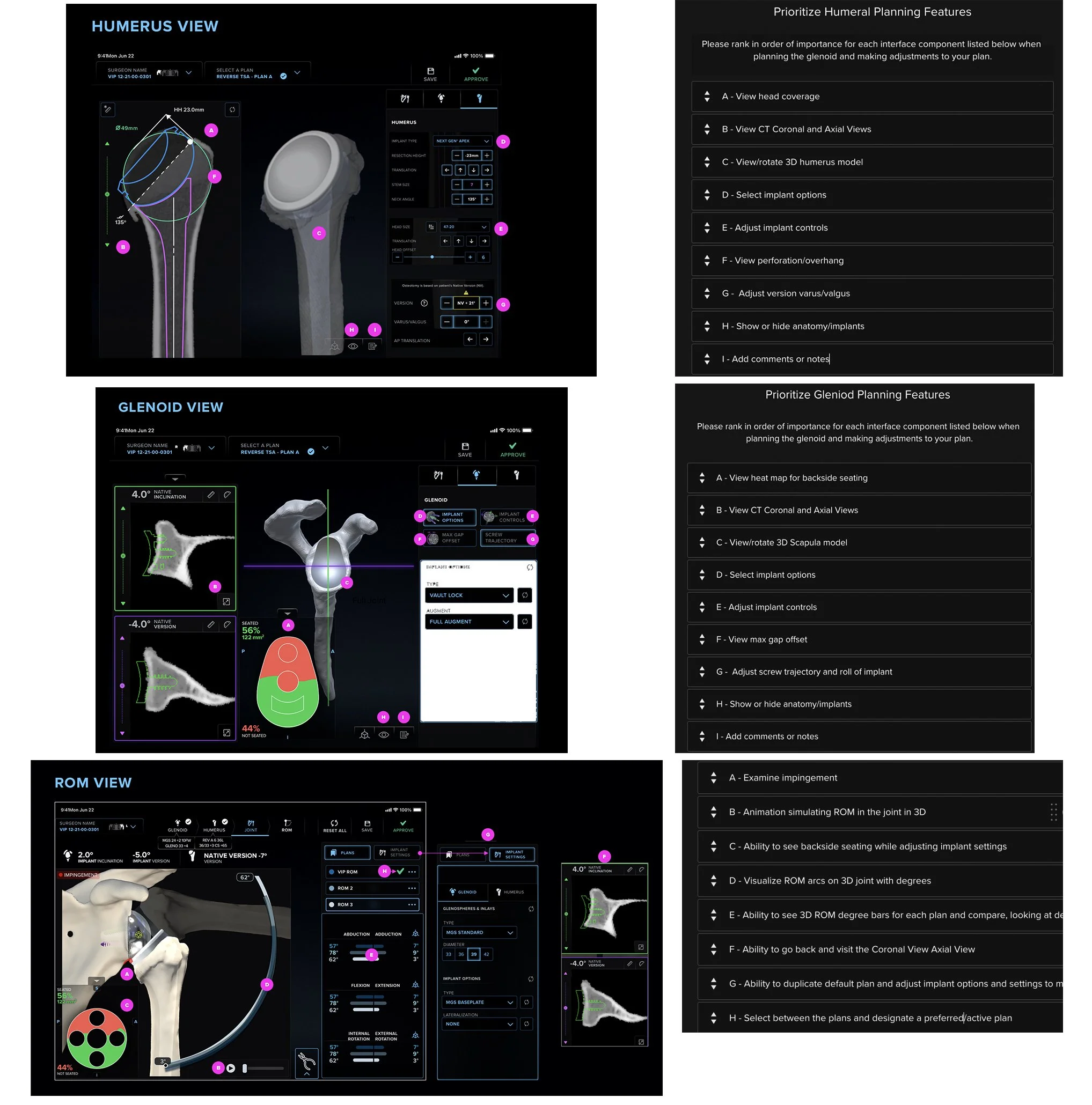
I called the visual approach game-inspired because we weren't boxed into standard web or app conventions. Touch and motion were real inputs, not just clicks, so I could shape navigation around what surgeons already recognized from their own clinical practice and study materials, not around what a button is supposed to look like. The goal was instant recognition under pressure, without needing to read a guide, even though we kept one on hand next to the hardware.
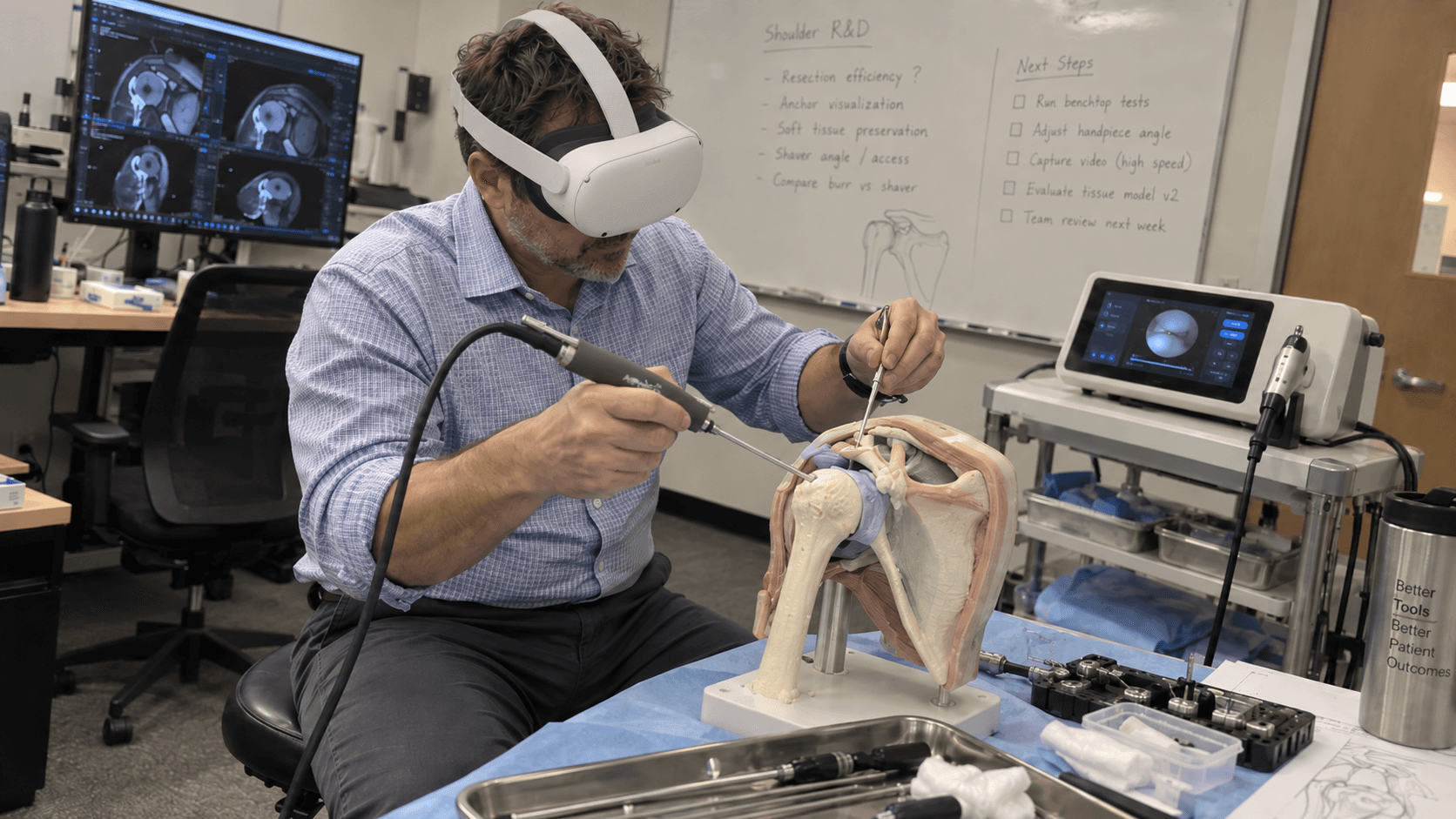
The thing I'm proudest of came out of a hackathon. I experimented with a VR headset to see if it could apply to surgical planning, and found it was accurate enough to matter. That became a second product, a VR-based planning and practice tool built to adapt to any headset, not tied to one device. It wasn't built for every surgeon, but it went into production, received FDA approval, and was used in live surgeries.
Outcome
Planning-to-operation time reduced 35–52%
VR-based planning tool reduced the surgical error window by 2–4 degrees, translating to greater post-op range of motion for patients
Delivered to production in about 7 months
FDA approval secured for the VR-based planning tool
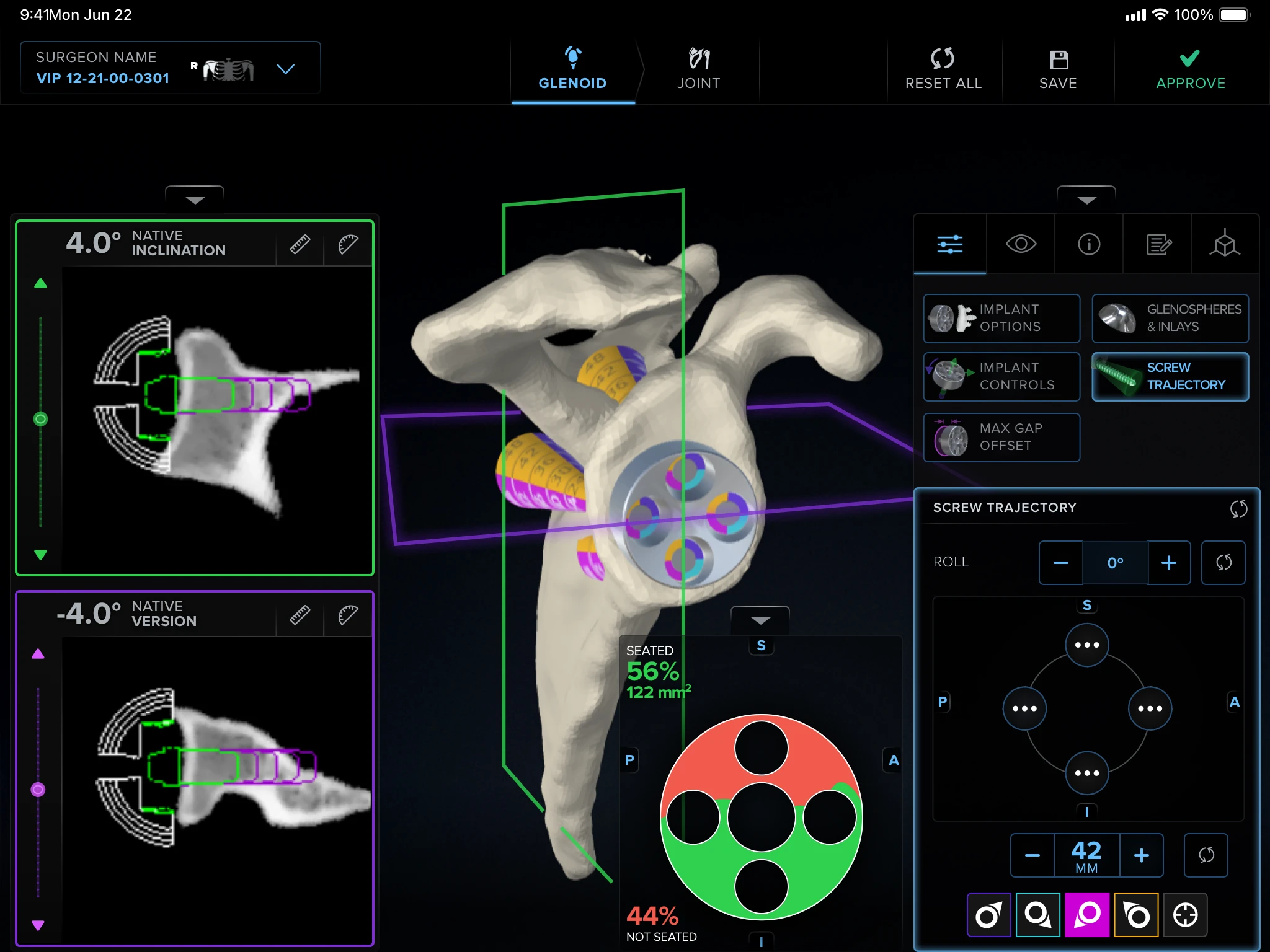
Both products shipped and are in active use. After I left, I stayed in touch with the a few from sales team , who reported strong customer satisfaction, surgeons and nurses preferred the new web, iPad, and mobile experience over the legacy system, and specifically called out the mobile screw-trajectory feature as a good value add.
I was on this project total 10 months, the last two mostly spent overseeing engineering and QA through production.
Reflection
The ask here was planning software. And being curious about something unrelated, a VR headset sitting in the lab, and asking a simple "can we test this?" turned into a second product that mattered more to patient outcomes than anything I'd been asked to build. Here, that outcome was measured in a surgeon's margin for error, and a patient's range of motion after.
Precision Tools for Shoulder Arthroplasty
Redesigned Arthrex's pre-operative planning s oftware, cutting planning-to-operation time 35–52% and reducing surgical error margins with a VR-based planning tool.
MedTech
Robotics
Pre-operative Planning Software
Human Factors
UX
Arthrex
About This Project
The Challenge
In total shoulder arthroplasty, outcome comes down to one thing more than almost anything else: how well the implant is positioned. Positioning is what determines a patient's post-op range of motion, and whether the surgeon runs into a bony impingement mid-procedure they didn't see coming. Before this project, surgeons had limited ability to see or compare that outcome ahead of time, they were largely deciding on positioning once they were already in the OR. Arthrex wanted software that could take a patient's own CT scan, build it into a 3D model, and let the surgeon simulate and compare implant positions against it, checking for range of motion and impingement risk, before making a single cut.
There was a second layer once the surgeon was actually in the room: whatever was planned had to hold up on embedded hardware with limited pixels and a restricted color palette, where color choices carry real clinical meaning and can't be treated like ordinary interface decisions.
This is one of Arthrex's highest-value product lines, and one of the most common shoulder surgeries performed by clients.
How I Approached It
I owned this from the start, research, design direction, and workshop facilitation. There was no traditional product team. The closest thing to product owners were sales reps, who doubled as the surgeons' main point of contact and knew the clinical side of this product better than most of the company did. My actual collaborators were industrial design engineers, a 3D engineering team, robotics engineers, a human factors researcher, QA, and engineering, plus a cadaver lab, where we got real anatomical parts, 3D printed them, and tested the planning software's predictions against reality.
I ran a formative assessment to see how surgeons actually understood the system mid-decision, mid-surgery. That surfaced things a typical UX study wouldn't: how far apart devices needed to sit for readability, what audio patterns worked given limited audio capability, what haptic feedback needed to feel like in a remote a surgeon can't look down at. I shaped the physical design of the handles and remotes for the robotics hardware itself, this wasn't a screen-only project. Testing happened between live surgeries at surgery centers, pop-ups where surgeons tried device variations in the gaps between procedures.
The color and badge system became the production design language across each surface: embedded hardware, iPad, desktop, and mobile. It solved a measured problem, misreads and confusion between visually similar elements, the kind of error that matters more in an operating room than almost anywhere else.
What We Built
The core product was Virtual Implant Positioning, a web and iPad app for surgical planning, plus a separate mobile companion for screw trajectory, plus custom embedded software running on the hardware itself. I designed the interface layer across it all, defining controls in the challenge it talks about how you know because we are very different visuals but you can't good version?, how they were labeled, the icon language, the color logic, consistent from the screen down to the physical hardware.
I called the visual approach game-inspired because we weren't boxed into standard web or app conventions. Touch and motion were real inputs, not just clicks, so I could shape navigation around what surgeons already recognized from their own clinical practice and study materials, not around what a button is supposed to look like. The goal was instant recognition under pressure, without needing to read a guide, even though we kept one on hand next to the hardware.
The thing I'm proudest of came out of a hackathon. I experimented with a VR headset to see if it could apply to surgical planning, and found it was accurate enough to matter. That became a second product, a VR-based planning and practice tool built to adapt to any headset, not tied to one device. It wasn't built for every surgeon, but it went into production, received FDA approval, and was used in live surgeries.
Outcome
Planning-to-operation time reduced 35–52%
VR-based planning tool reduced the surgical error window by 2–4 degrees, translating to greater post-op range of motion for patients
Delivered to production in about 7 months
FDA approval secured for the VR-based planning tool
Both products shipped and are in active use. After I left, I stayed in touch with the a few from sales team , who reported strong customer satisfaction, surgeons and nurses preferred the new web, iPad, and mobile experience over the legacy system, and specifically called out the mobile screw-trajectory feature as a good value add.
I was on this project total 10 months, the last two mostly spent overseeing engineering and QA through production.
Reflection
The ask here was planning software. And being curious about something unrelated, a VR headset sitting in the lab, and asking a simple "can we test this?" turned into a second product that mattered more to patient outcomes than anything I'd been asked to build. Here, that outcome was measured in a surgeon's margin for error, and a patient's range of motion after.
Precision Tools for Shoulder Arthroplasty
Redesigned Arthrex's pre-operative planning s oftware, cutting planning-to-operation time 35–52% and reducing surgical error margins with a VR-based planning tool.
MedTech
Robotics
Pre-operative Planning Software
Human Factors
UX
Arthrex
About This Project
The Challenge
In total shoulder arthroplasty, outcome comes down to one thing more than almost anything else: how well the implant is positioned. Positioning is what determines a patient's post-op range of motion, and whether the surgeon runs into a bony impingement mid-procedure they didn't see coming. Before this project, surgeons had limited ability to see or compare that outcome ahead of time, they were largely deciding on positioning once they were already in the OR. Arthrex wanted software that could take a patient's own CT scan, build it into a 3D model, and let the surgeon simulate and compare implant positions against it, checking for range of motion and impingement risk, before making a single cut.
There was a second layer once the surgeon was actually in the room: whatever was planned had to hold up on embedded hardware with limited pixels and a restricted color palette, where color choices carry real clinical meaning and can't be treated like ordinary interface decisions.
This is one of Arthrex's highest-value product lines, and one of the most common shoulder surgeries performed by clients.
How I Approached It
I owned this from the start, research, design direction, and workshop facilitation. There was no traditional product team. The closest thing to product owners were sales reps, who doubled as the surgeons' main point of contact and knew the clinical side of this product better than most of the company did. My actual collaborators were industrial design engineers, a 3D engineering team, robotics engineers, a human factors researcher, QA, and engineering, plus a cadaver lab, where we got real anatomical parts, 3D printed them, and tested the planning software's predictions against reality.
I ran a formative assessment to see how surgeons actually understood the system mid-decision, mid-surgery. That surfaced things a typical UX study wouldn't: how far apart devices needed to sit for readability, what audio patterns worked given limited audio capability, what haptic feedback needed to feel like in a remote a surgeon can't look down at. I shaped the physical design of the handles and remotes for the robotics hardware itself, this wasn't a screen-only project. Testing happened between live surgeries at surgery centers, pop-ups where surgeons tried device variations in the gaps between procedures.
The color and badge system became the production design language across each surface: embedded hardware, iPad, desktop, and mobile. It solved a measured problem, misreads and confusion between visually similar elements, the kind of error that matters more in an operating room than almost anywhere else.
What We Built
The core product was Virtual Implant Positioning, a web and iPad app for surgical planning, plus a separate mobile companion for screw trajectory, plus custom embedded software running on the hardware itself. I designed the interface layer across it all, defining controls in the challenge it talks about how you know because we are very different visuals but you can't good version?, how they were labeled, the icon language, the color logic, consistent from the screen down to the physical hardware.
I called the visual approach game-inspired because we weren't boxed into standard web or app conventions. Touch and motion were real inputs, not just clicks, so I could shape navigation around what surgeons already recognized from their own clinical practice and study materials, not around what a button is supposed to look like. The goal was instant recognition under pressure, without needing to read a guide, even though we kept one on hand next to the hardware.
The thing I'm proudest of came out of a hackathon. I experimented with a VR headset to see if it could apply to surgical planning, and found it was accurate enough to matter. That became a second product, a VR-based planning and practice tool built to adapt to any headset, not tied to one device. It wasn't built for every surgeon, but it went into production, received FDA approval, and was used in live surgeries.
Outcome
Planning-to-operation time reduced 35–52%
VR-based planning tool reduced the surgical error window by 2–4 degrees, translating to greater post-op range of motion for patients
Delivered to production in about 7 months
FDA approval secured for the VR-based planning tool
Both products shipped and are in active use. After I left, I stayed in touch with the a few from sales team , who reported strong customer satisfaction, surgeons and nurses preferred the new web, iPad, and mobile experience over the legacy system, and specifically called out the mobile screw-trajectory feature as a good value add.
I was on this project total 10 months, the last two mostly spent overseeing engineering and QA through production.
Reflection
The ask here was planning software. And being curious about something unrelated, a VR headset sitting in the lab, and asking a simple "can we test this?" turned into a second product that mattered more to patient outcomes than anything I'd been asked to build. Here, that outcome was measured in a surgeon's margin for error, and a patient's range of motion after.
Precision Tools for Shoulder Arthroplasty
Redesigned Arthrex's pre-operative planning s oftware, cutting planning-to-operation time 35–52% and reducing surgical error margins with a VR-based planning tool.
MedTech
Robotics
Pre-operative Planning Software
Human Factors
UX
Arthrex
About This Project
The Challenge
In total shoulder arthroplasty, outcome comes down to one thing more than almost anything else: how well the implant is positioned. Positioning is what determines a patient's post-op range of motion, and whether the surgeon runs into a bony impingement mid-procedure they didn't see coming. Before this project, surgeons had limited ability to see or compare that outcome ahead of time, they were largely deciding on positioning once they were already in the OR. Arthrex wanted software that could take a patient's own CT scan, build it into a 3D model, and let the surgeon simulate and compare implant positions against it, checking for range of motion and impingement risk, before making a single cut.
There was a second layer once the surgeon was actually in the room: whatever was planned had to hold up on embedded hardware with limited pixels and a restricted color palette, where color choices carry real clinical meaning and can't be treated like ordinary interface decisions.
This is one of Arthrex's highest-value product lines, and one of the most common shoulder surgeries performed by clients.
How I Approached It
I owned this from the start, research, design direction, and workshop facilitation. There was no traditional product team. The closest thing to product owners were sales reps, who doubled as the surgeons' main point of contact and knew the clinical side of this product better than most of the company did. My actual collaborators were industrial design engineers, a 3D engineering team, robotics engineers, a human factors researcher, QA, and engineering, plus a cadaver lab, where we got real anatomical parts, 3D printed them, and tested the planning software's predictions against reality.
I ran a formative assessment to see how surgeons actually understood the system mid-decision, mid-surgery. That surfaced things a typical UX study wouldn't: how far apart devices needed to sit for readability, what audio patterns worked given limited audio capability, what haptic feedback needed to feel like in a remote a surgeon can't look down at. I shaped the physical design of the handles and remotes for the robotics hardware itself, this wasn't a screen-only project. Testing happened between live surgeries at surgery centers, pop-ups where surgeons tried device variations in the gaps between procedures.
The color and badge system became the production design language across each surface: embedded hardware, iPad, desktop, and mobile. It solved a measured problem, misreads and confusion between visually similar elements, the kind of error that matters more in an operating room than almost anywhere else.
What We Built
The core product was Virtual Implant Positioning, a web and iPad app for surgical planning, plus a separate mobile companion for screw trajectory, plus custom embedded software running on the hardware itself. I designed the interface layer across it all, defining controls in the challenge it talks about how you know because we are very different visuals but you can't good version?, how they were labeled, the icon language, the color logic, consistent from the screen down to the physical hardware.
I called the visual approach game-inspired because we weren't boxed into standard web or app conventions. Touch and motion were real inputs, not just clicks, so I could shape navigation around what surgeons already recognized from their own clinical practice and study materials, not around what a button is supposed to look like. The goal was instant recognition under pressure, without needing to read a guide, even though we kept one on hand next to the hardware.
The thing I'm proudest of came out of a hackathon. I experimented with a VR headset to see if it could apply to surgical planning, and found it was accurate enough to matter. That became a second product, a VR-based planning and practice tool built to adapt to any headset, not tied to one device. It wasn't built for every surgeon, but it went into production, received FDA approval, and was used in live surgeries.
Outcome
Planning-to-operation time reduced 35–52%
VR-based planning tool reduced the surgical error window by 2–4 degrees, translating to greater post-op range of motion for patients
Delivered to production in about 7 months
FDA approval secured for the VR-based planning tool
Both products shipped and are in active use. After I left, I stayed in touch with the a few from sales team , who reported strong customer satisfaction, surgeons and nurses preferred the new web, iPad, and mobile experience over the legacy system, and specifically called out the mobile screw-trajectory feature as a good value add.
I was on this project total 10 months, the last two mostly spent overseeing engineering and QA through production.
Reflection
The ask here was planning software. And being curious about something unrelated, a VR headset sitting in the lab, and asking a simple "can we test this?" turned into a second product that mattered more to patient outcomes than anything I'd been asked to build. Here, that outcome was measured in a surgeon's margin for error, and a patient's range of motion after.