
Walt Disney Studios
About This Project
$3M in fees eliminated, year one
48% faster processing per submission
First junior hire — a role that wasn't possible on the old system
One platform replaced a 25-year-old payment system behind over $2B a year in residuals across 46,000 titles. Disney's Residuals team paid talent under constantly shifting guild rules on a tool that couldn't keep up, so the team built the rest of the process by hand, around it. I led the redesign from research through production: a system built to carry that scale and stay current with the rules governing it.
The Challenge
Residual payments are governed by guild agreements: SAG-AFTRA, WGA, DGA, and others. The rules change every one to three years, with addendums in between. When the rules change, the math changes.
The internal tool, ReRun, was built for a version of this process that no longer existed. It couldn't absorb rule changes. It couldn't complete a setup end to end. So the team built the rest of the process around it.
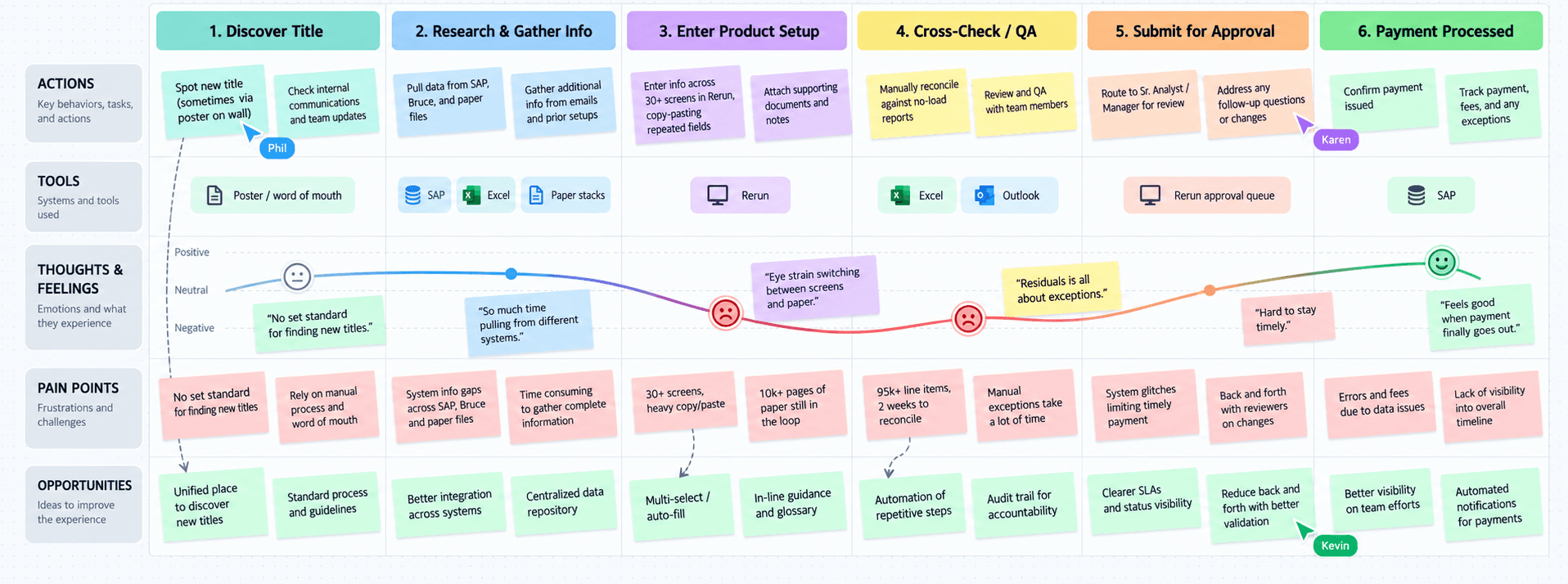
New titles were sometimes discovered by a poster on the wall. There was no standard for finding out what needed to be paid.
A single product setup meant switching between 30 or more screens and copy-pasting the same information repeatedly.
Reconciling one report type meant 95,000 line items and two weeks of work, in Excel.
The director handled 400 emails a day. Her description of a slow day: 25 fires put out by 2pm.
The manager, who owned assignments and guild communication, wasn't in the system at all. Her tools were SAP, a top sheet, and 10,000-plus pages of paper.
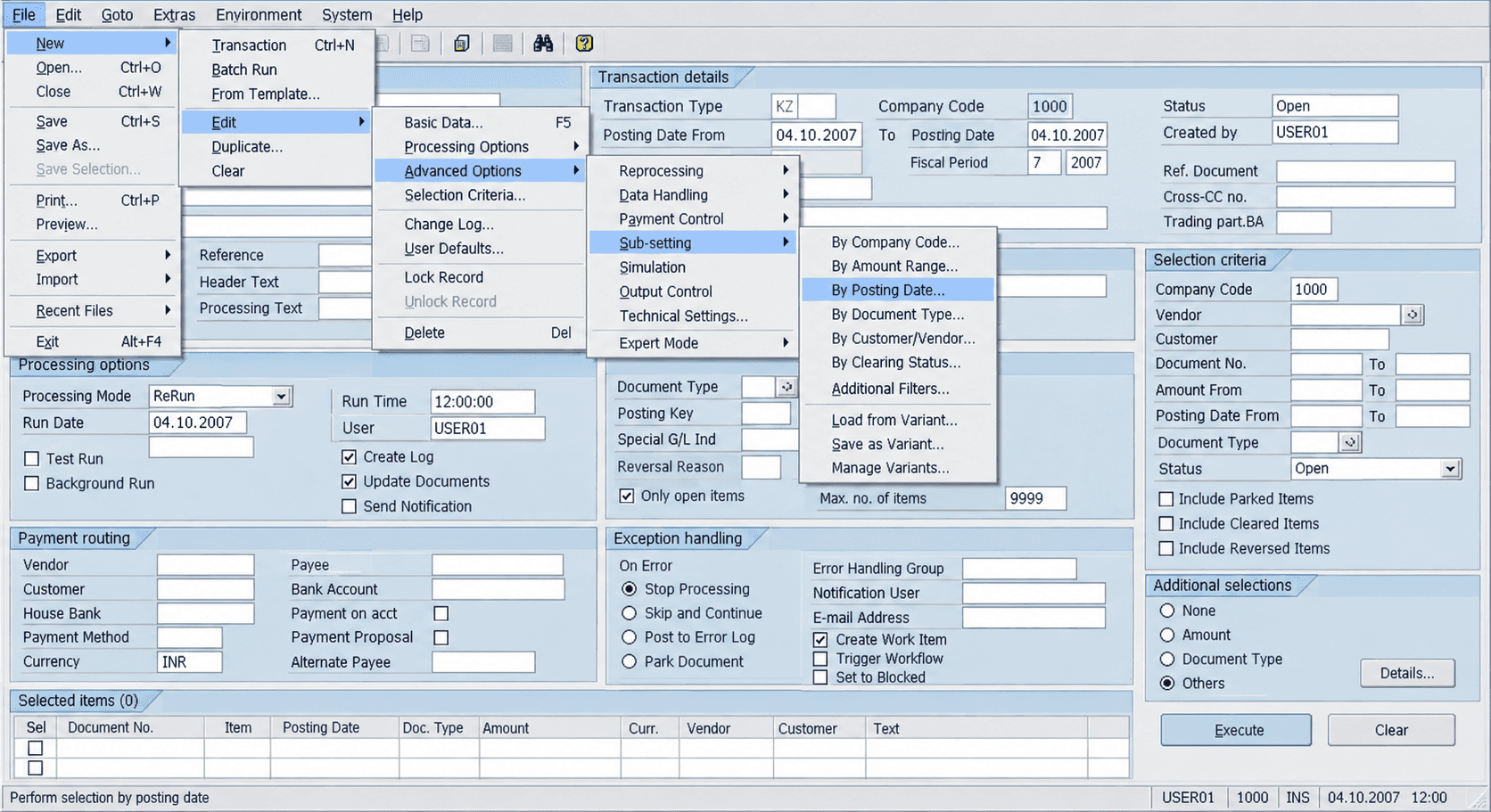
Previous tools experience was full of frustration and inefficient UI patterns.
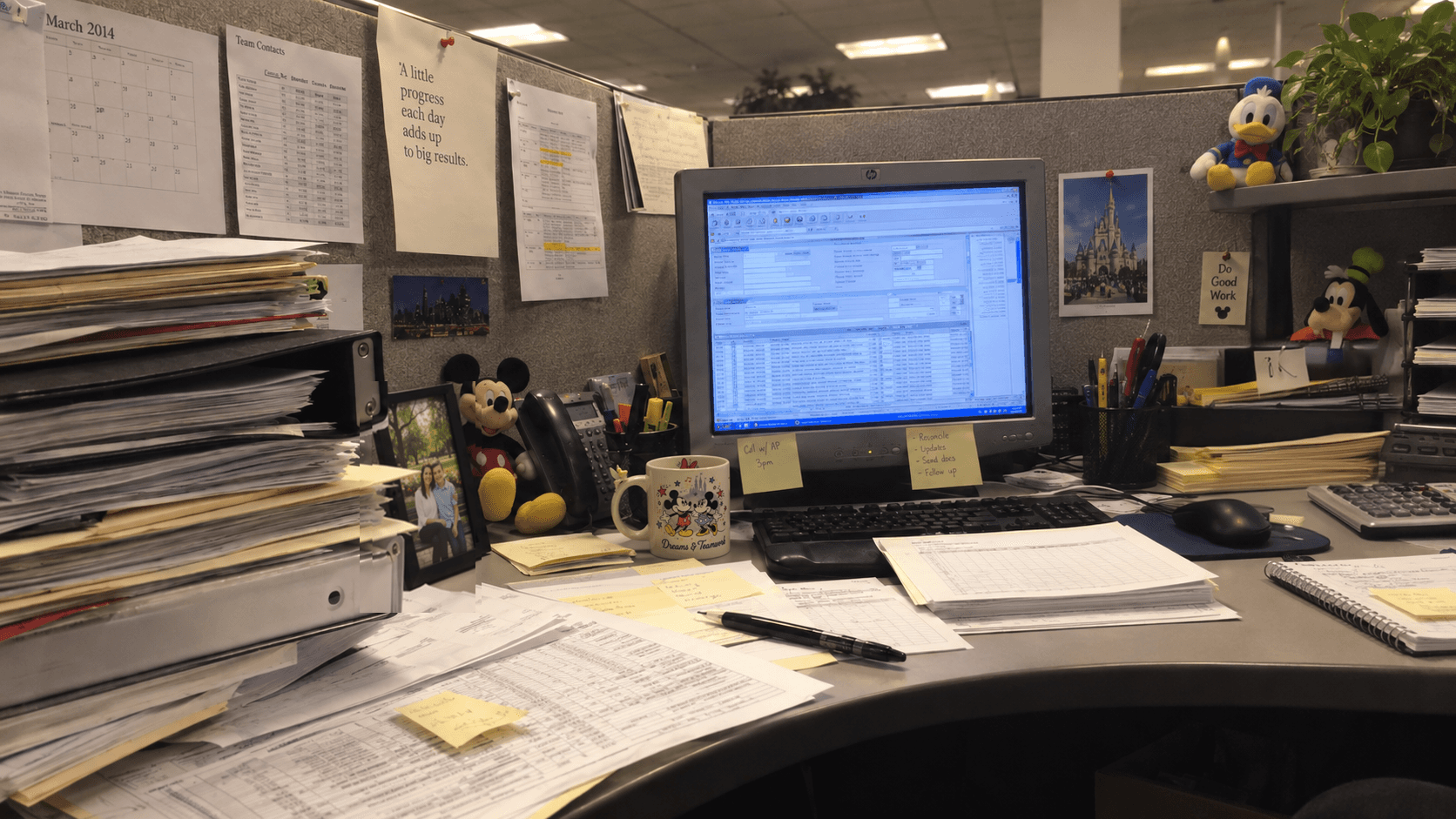
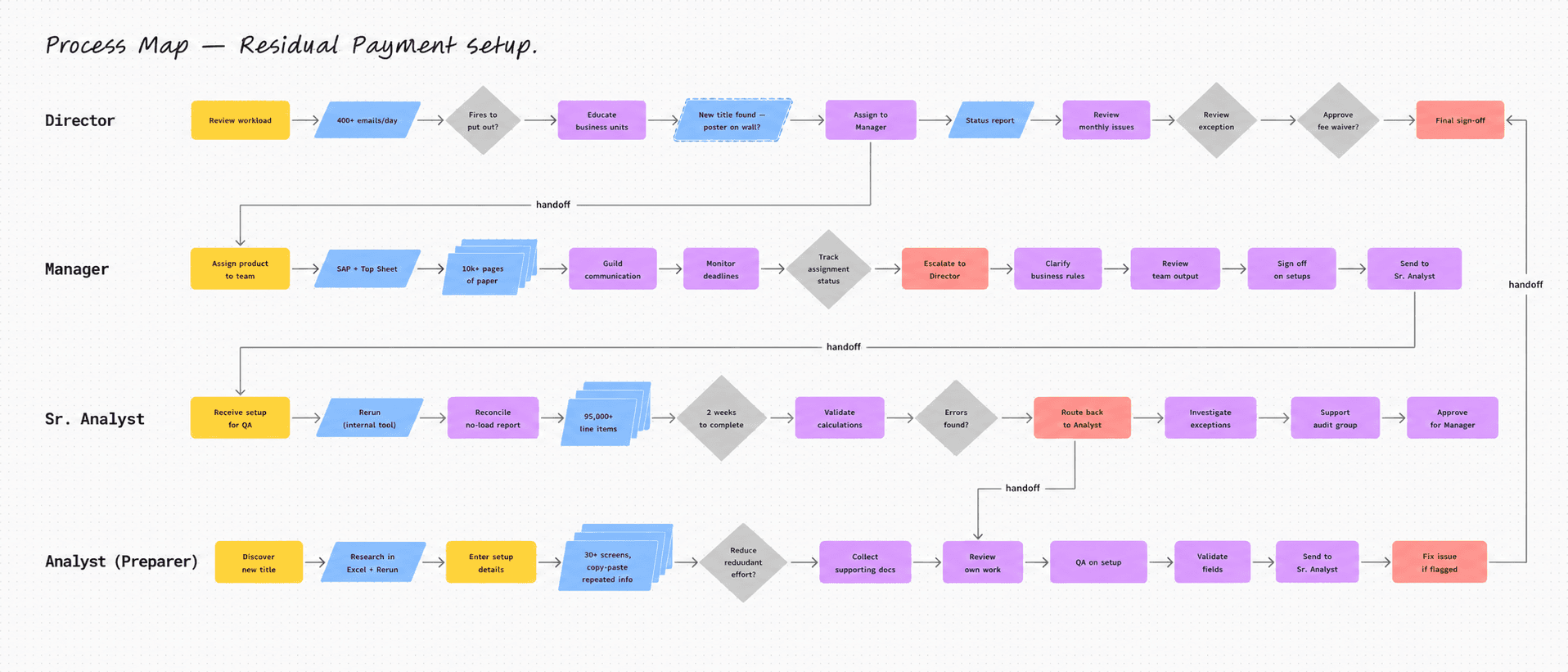
Handoffs were messy because everyone had patched their own version of the process. Late payments and setup errors carried penalties. The senior analysts who could hold the whole thing in their heads were expensive to keep, and there was no realistic way to onboard anyone junior.
How I Approached It
The plan I inherited went screen by screen. Take the existing tool, tighten each view, make it more efficient. It was a reasonable plan if the screens were the problem. Once I saw what was actually being processed, it was clear they weren't. The process was.
This was a second attempt on a project that had already gone over budget. A full pivot was a real risk to propose. I brought it to my director first, so the conversation with the product owner came from leadership, not just from the design lead.
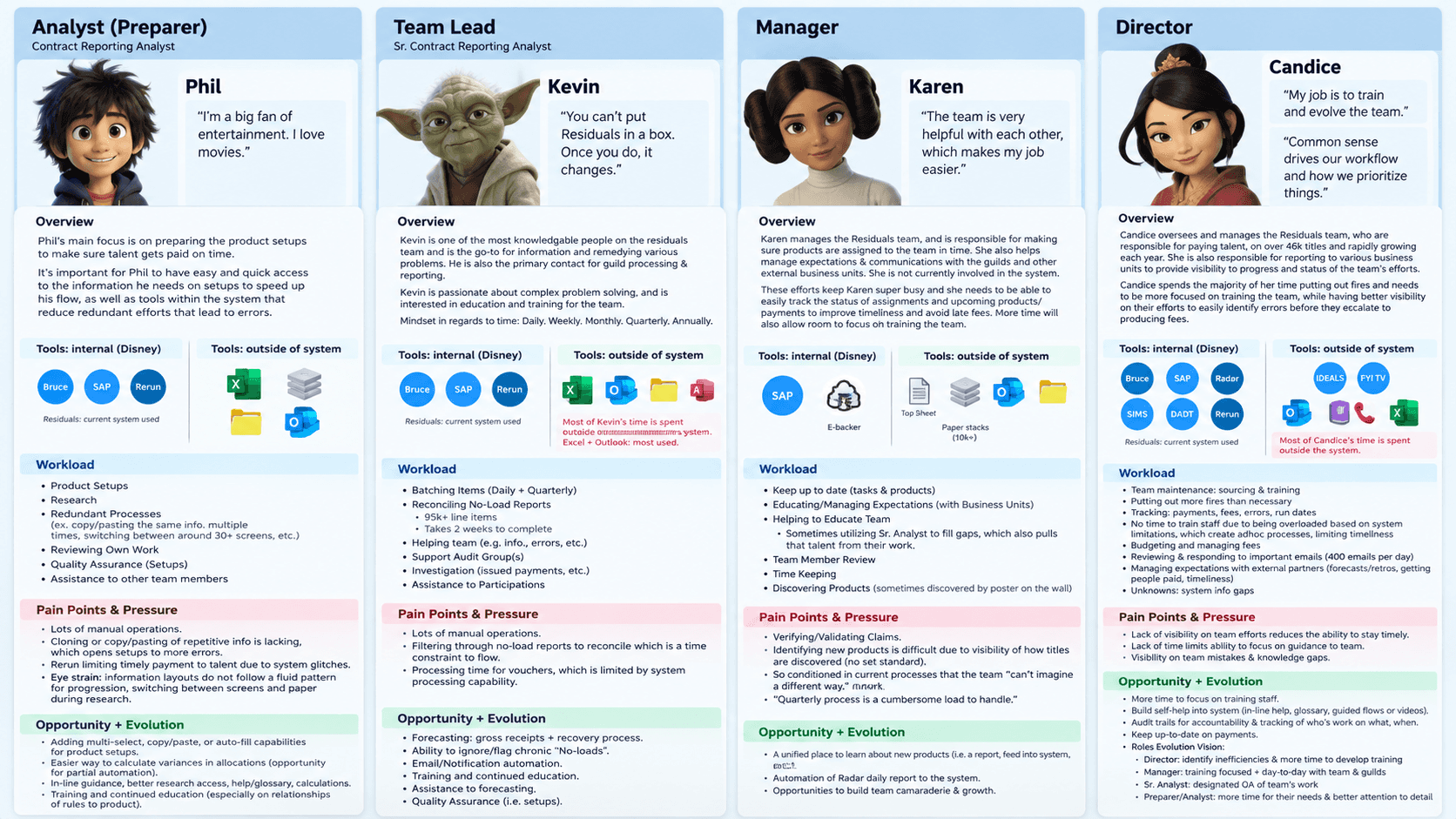
Interviews, shadowing, and lab testing with all nine analysts. Eye tracking. Think-aloud sessions. We mapped every tool each role touched, inside and outside the system, and every point where someone left the software for paper or a spreadsheet.
What We Built
The old tool was dropdowns inside dropdowns, three levels deep. We rebuilt the whole thing around three layers.
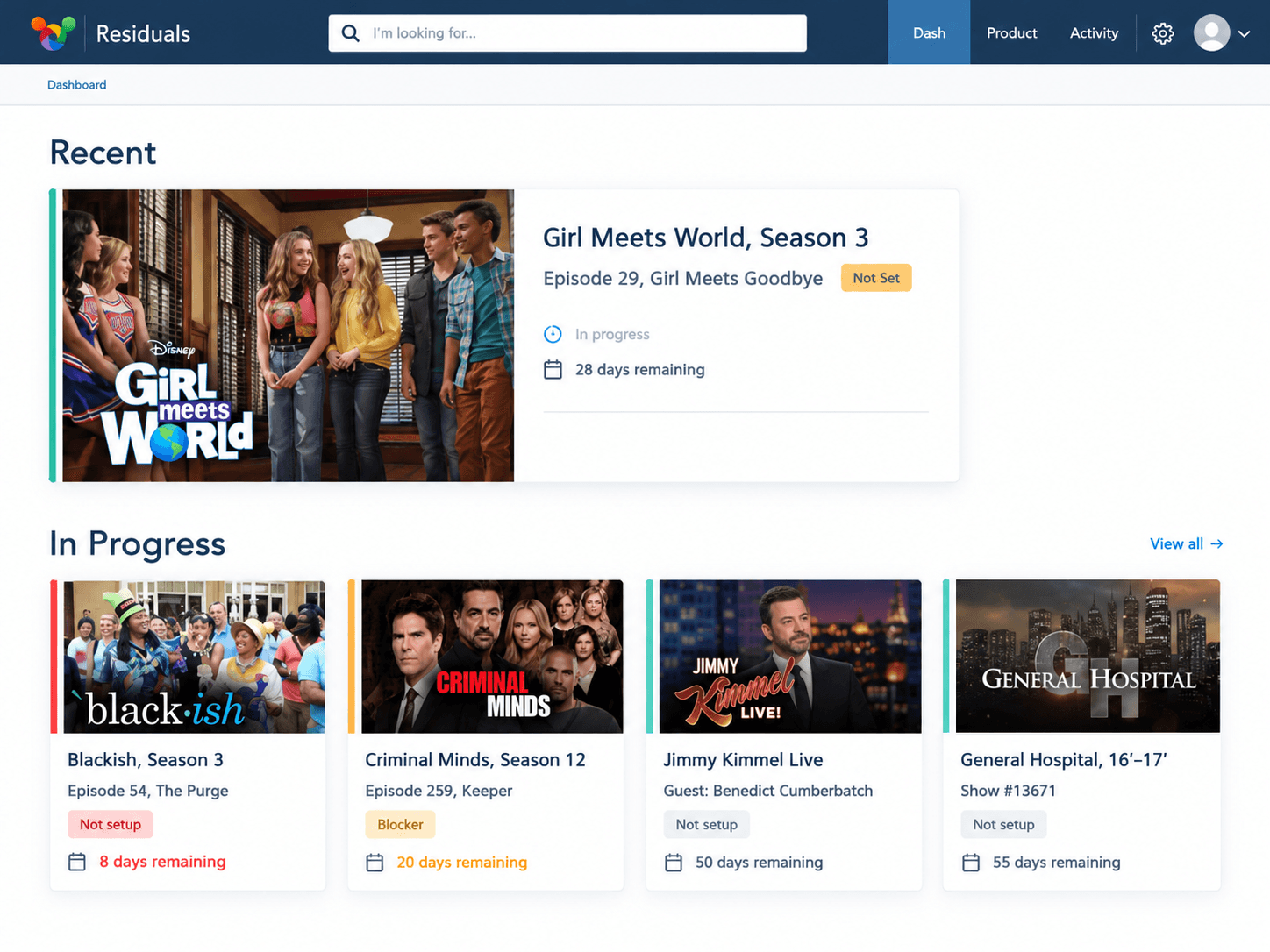
Dash. Each analyst's live view. What's assigned, what's in progress, days remaining color-coded by urgency. We gave it a streaming-platform visual language, title art for every production, so an analyst who's never seen a show still has context.
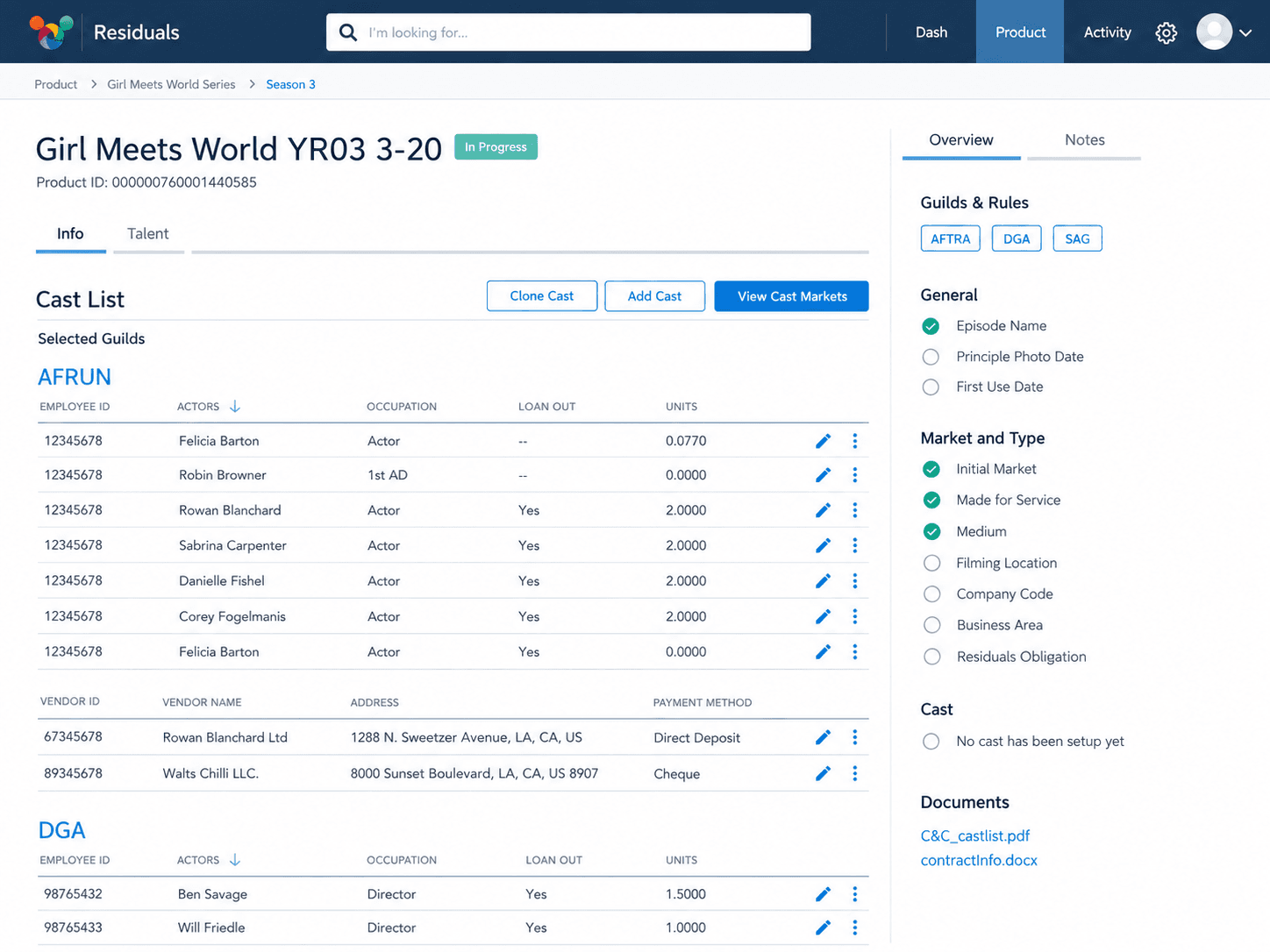
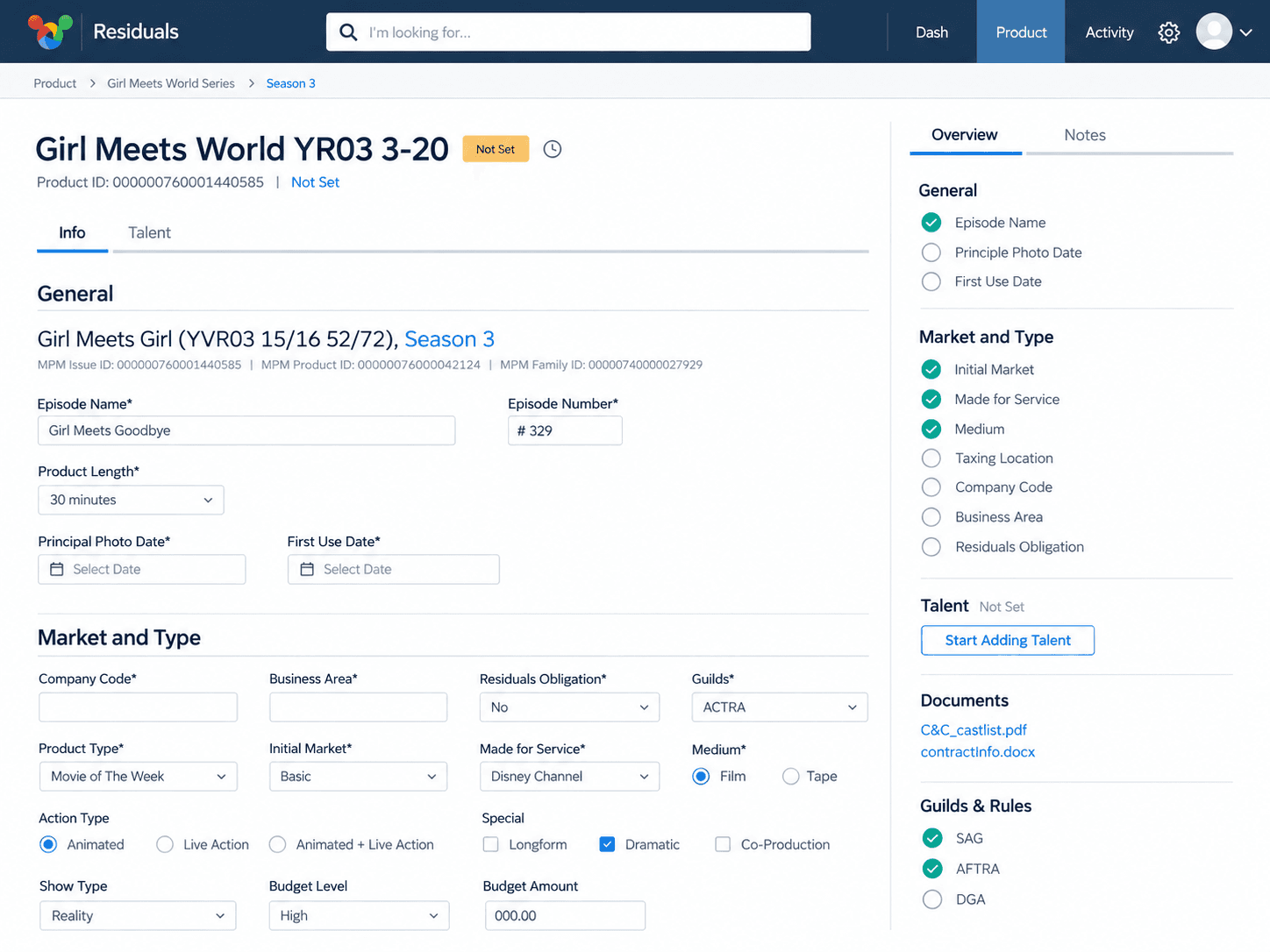
Product. The work itself. A guided two-step setup replaced 30-plus screens: enter product info, add cast. Guild rules live in a side panel. Auto-fill handles the repetition. Events queue up with due dates and three actions: approve, hold, reject.
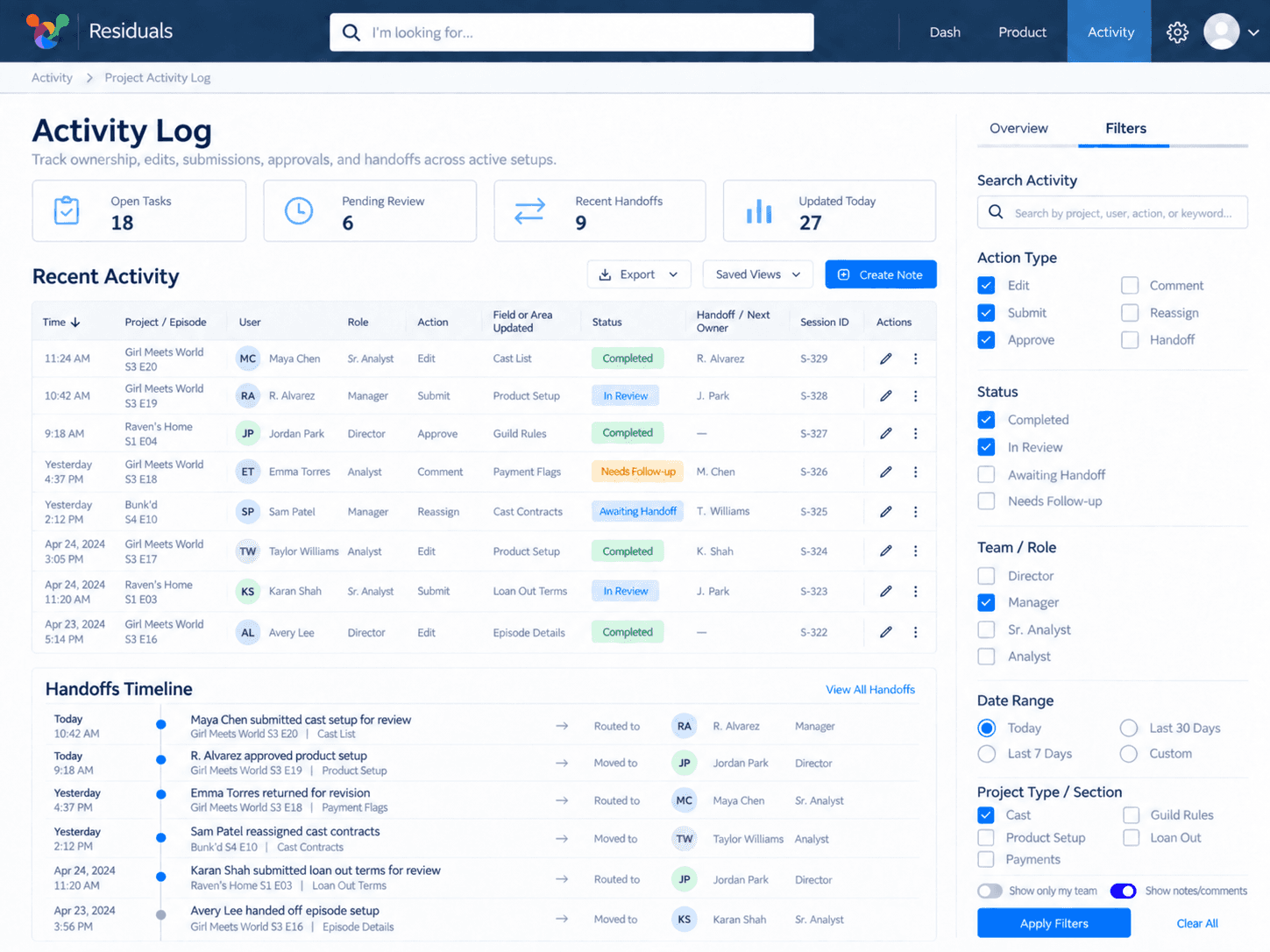
Activity. The audit layer. Every action traced to a person and a time. When an audit comes, the trail is already there.
Before, a rule change was a verbal announcement and everyone adjusted their own process. Now leads and the director push a rule change into the system globally the moment it's known. Every analyst runs on the same rules from that point. Under that sits a rules engine, tag-based auto-categorization with human confirmation, anomaly detection, forecasting, and document parsing.
The manager said it in research: "Disney is Disney. Everyone should enjoy themselves and lighten up." So we licensed character voices and built completion sounds and messages into the submission flow. It's an element o delight to top of a high stress process. It's also the thing the team talked about most beyond the easing of their process.

Outcome
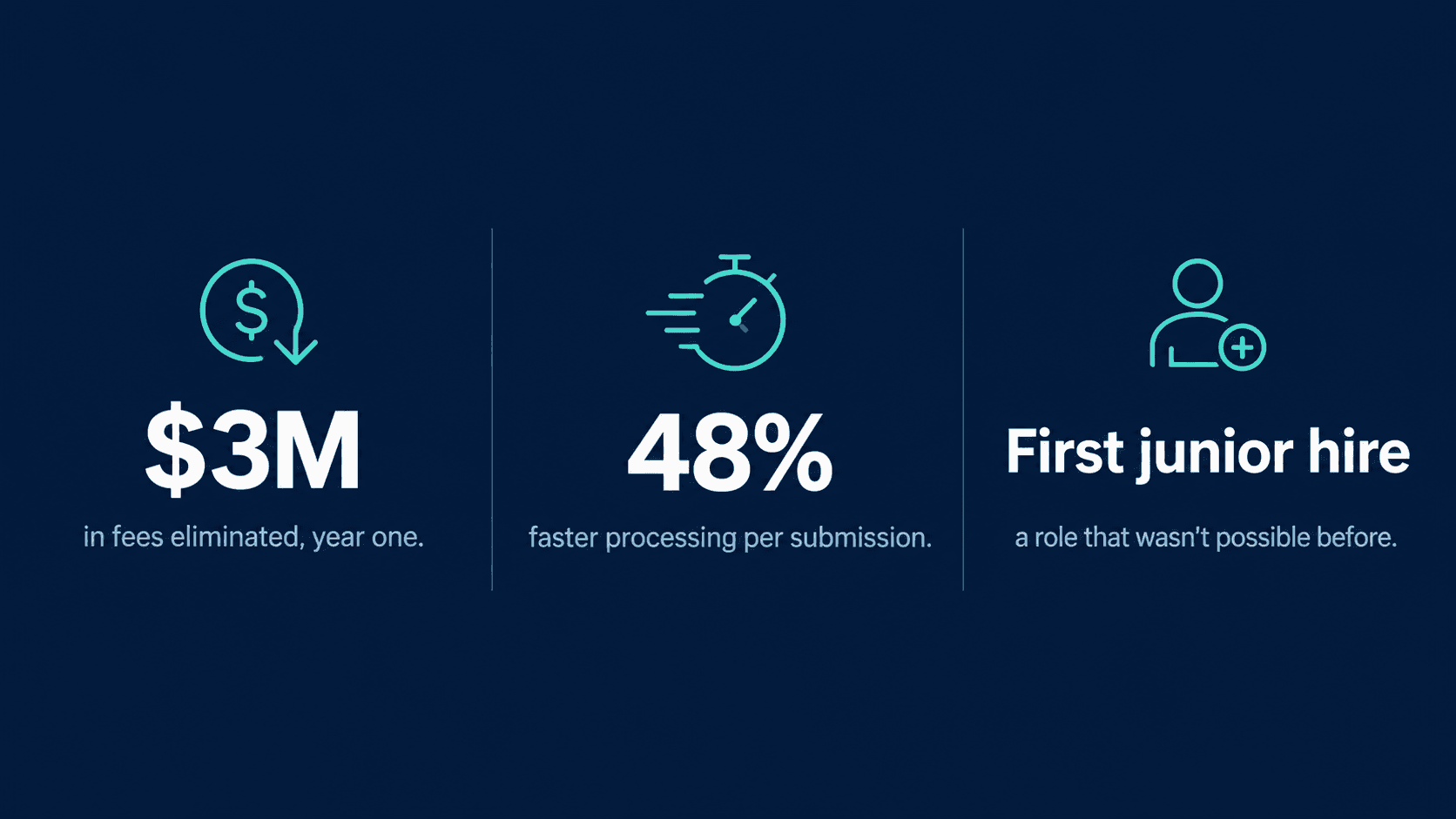
In the first year, the platform eliminated $3M in fees that had been caused directly by the old system's errors. Processing time per submission dropped 48%. The director confirmed the team hired and onboarded its first junior analyst within a year of launch, a hire that wasn't possible before.
Errors caused by the broken, disconnected process are gone. The errors that remain are data-entry level, and Activity catches them before they become a fee instead of after.
The team that had been coaching each other through a 25-year-old system now runs on one they trust to last another 25.
Reflection
Residuals ran across a system that couldn't keep up, stacks of paper, folders, and a database that never added up to a clean audit trail. The project started as a set of screen edits. Once I saw the pattern, the process was the problem, not the screens, we used research to validate a proof of concept and rebuilt from zero: one source of truth that can be traced end to end, always current with the latest guild rules and math, and built to outlast the 25-year-old system it replaced.
The team already took pride in the job. They needed a product that let them do it well.
Walt Disney Studios
About This Project
$3M in fees eliminated, year one
48% faster processing per submission
First junior hire — a role that wasn't possible on the old system
One platform replaced a 25-year-old payment system behind over $2B a year in residuals across 46,000 titles. Disney's Residuals team paid talent under constantly shifting guild rules on a tool that couldn't keep up, so the team built the rest of the process by hand, around it. I led the redesign from research through production: a system built to carry that scale and stay current with the rules governing it.
The Challenge
Residual payments are governed by guild agreements: SAG-AFTRA, WGA, DGA, and others. The rules change every one to three years, with addendums in between. When the rules change, the math changes.
The internal tool, ReRun, was built for a version of this process that no longer existed. It couldn't absorb rule changes. It couldn't complete a setup end to end. So the team built the rest of the process around it.
New titles were sometimes discovered by a poster on the wall. There was no standard for finding out what needed to be paid.
A single product setup meant switching between 30 or more screens and copy-pasting the same information repeatedly.
Reconciling one report type meant 95,000 line items and two weeks of work, in Excel.
The director handled 400 emails a day. Her description of a slow day: 25 fires put out by 2pm.
The manager, who owned assignments and guild communication, wasn't in the system at all. Her tools were SAP, a top sheet, and 10,000-plus pages of paper.
Previous tools experience was full of frustration and inefficient UI patterns.
Handoffs were messy because everyone had patched their own version of the process. Late payments and setup errors carried penalties. The senior analysts who could hold the whole thing in their heads were expensive to keep, and there was no realistic way to onboard anyone junior.
How I Approached It
The plan I inherited went screen by screen. Take the existing tool, tighten each view, make it more efficient. It was a reasonable plan if the screens were the problem. Once I saw what was actually being processed, it was clear they weren't. The process was.
This was a second attempt on a project that had already gone over budget. A full pivot was a real risk to propose. I brought it to my director first, so the conversation with the product owner came from leadership, not just from the design lead.
Interviews, shadowing, and lab testing with all nine analysts. Eye tracking. Think-aloud sessions. We mapped every tool each role touched, inside and outside the system, and every point where someone left the software for paper or a spreadsheet.
What We Built
The old tool was dropdowns inside dropdowns, three levels deep. We rebuilt the whole thing around three layers.
Dash. Each analyst's live view. What's assigned, what's in progress, days remaining color-coded by urgency. We gave it a streaming-platform visual language, title art for every production, so an analyst who's never seen a show still has context.
Product. The work itself. A guided two-step setup replaced 30-plus screens: enter product info, add cast. Guild rules live in a side panel. Auto-fill handles the repetition. Events queue up with due dates and three actions: approve, hold, reject.
Activity. The audit layer. Every action traced to a person and a time. When an audit comes, the trail is already there.
Before, a rule change was a verbal announcement and everyone adjusted their own process. Now leads and the director push a rule change into the system globally the moment it's known. Every analyst runs on the same rules from that point. Under that sits a rules engine, tag-based auto-categorization with human confirmation, anomaly detection, forecasting, and document parsing.
The manager said it in research: "Disney is Disney. Everyone should enjoy themselves and lighten up." So we licensed character voices and built completion sounds and messages into the submission flow. It's an element o delight to top of a high stress process. It's also the thing the team talked about most beyond the easing of their process.
Outcome
In the first year, the platform eliminated $3M in fees that had been caused directly by the old system's errors. Processing time per submission dropped 48%. The director confirmed the team hired and onboarded its first junior analyst within a year of launch, a hire that wasn't possible before.
Errors caused by the broken, disconnected process are gone. The errors that remain are data-entry level, and Activity catches them before they become a fee instead of after.
The team that had been coaching each other through a 25-year-old system now runs on one they trust to last another 25.
Reflection
Residuals ran across a system that couldn't keep up, stacks of paper, folders, and a database that never added up to a clean audit trail. The project started as a set of screen edits. Once I saw the pattern, the process was the problem, not the screens, we used research to validate a proof of concept and rebuilt from zero: one source of truth that can be traced end to end, always current with the latest guild rules and math, and built to outlast the 25-year-old system it replaced.
The team already took pride in the job. They needed a product that let them do it well.
Walt Disney Studios
About This Project
$3M in fees eliminated, year one
48% faster processing per submission
First junior hire — a role that wasn't possible on the old system
One platform replaced a 25-year-old payment system behind over $2B a year in residuals across 46,000 titles. Disney's Residuals team paid talent under constantly shifting guild rules on a tool that couldn't keep up, so the team built the rest of the process by hand, around it. I led the redesign from research through production: a system built to carry that scale and stay current with the rules governing it.
The Challenge
Residual payments are governed by guild agreements: SAG-AFTRA, WGA, DGA, and others. The rules change every one to three years, with addendums in between. When the rules change, the math changes.
The internal tool, ReRun, was built for a version of this process that no longer existed. It couldn't absorb rule changes. It couldn't complete a setup end to end. So the team built the rest of the process around it.
New titles were sometimes discovered by a poster on the wall. There was no standard for finding out what needed to be paid.
A single product setup meant switching between 30 or more screens and copy-pasting the same information repeatedly.
Reconciling one report type meant 95,000 line items and two weeks of work, in Excel.
The director handled 400 emails a day. Her description of a slow day: 25 fires put out by 2pm.
The manager, who owned assignments and guild communication, wasn't in the system at all. Her tools were SAP, a top sheet, and 10,000-plus pages of paper.
Previous tools experience was full of frustration and inefficient UI patterns.
Handoffs were messy because everyone had patched their own version of the process. Late payments and setup errors carried penalties. The senior analysts who could hold the whole thing in their heads were expensive to keep, and there was no realistic way to onboard anyone junior.
How I Approached It
The plan I inherited went screen by screen. Take the existing tool, tighten each view, make it more efficient. It was a reasonable plan if the screens were the problem. Once I saw what was actually being processed, it was clear they weren't. The process was.
This was a second attempt on a project that had already gone over budget. A full pivot was a real risk to propose. I brought it to my director first, so the conversation with the product owner came from leadership, not just from the design lead.
Interviews, shadowing, and lab testing with all nine analysts. Eye tracking. Think-aloud sessions. We mapped every tool each role touched, inside and outside the system, and every point where someone left the software for paper or a spreadsheet.
What We Built
The old tool was dropdowns inside dropdowns, three levels deep. We rebuilt the whole thing around three layers.
Dash. Each analyst's live view. What's assigned, what's in progress, days remaining color-coded by urgency. We gave it a streaming-platform visual language, title art for every production, so an analyst who's never seen a show still has context.
Product. The work itself. A guided two-step setup replaced 30-plus screens: enter product info, add cast. Guild rules live in a side panel. Auto-fill handles the repetition. Events queue up with due dates and three actions: approve, hold, reject.
Activity. The audit layer. Every action traced to a person and a time. When an audit comes, the trail is already there.
Before, a rule change was a verbal announcement and everyone adjusted their own process. Now leads and the director push a rule change into the system globally the moment it's known. Every analyst runs on the same rules from that point. Under that sits a rules engine, tag-based auto-categorization with human confirmation, anomaly detection, forecasting, and document parsing.
The manager said it in research: "Disney is Disney. Everyone should enjoy themselves and lighten up." So we licensed character voices and built completion sounds and messages into the submission flow. It's an element o delight to top of a high stress process. It's also the thing the team talked about most beyond the easing of their process.
Outcome
In the first year, the platform eliminated $3M in fees that had been caused directly by the old system's errors. Processing time per submission dropped 48%. The director confirmed the team hired and onboarded its first junior analyst within a year of launch, a hire that wasn't possible before.
Errors caused by the broken, disconnected process are gone. The errors that remain are data-entry level, and Activity catches them before they become a fee instead of after.
The team that had been coaching each other through a 25-year-old system now runs on one they trust to last another 25.
Reflection
Residuals ran across a system that couldn't keep up, stacks of paper, folders, and a database that never added up to a clean audit trail. The project started as a set of screen edits. Once I saw the pattern, the process was the problem, not the screens, we used research to validate a proof of concept and rebuilt from zero: one source of truth that can be traced end to end, always current with the latest guild rules and math, and built to outlast the 25-year-old system it replaced.
The team already took pride in the job. They needed a product that let them do it well.
Walt Disney Studios
About This Project
$3M in fees eliminated, year one
48% faster processing per submission
First junior hire — a role that wasn't possible on the old system
One platform replaced a 25-year-old payment system behind over $2B a year in residuals across 46,000 titles. Disney's Residuals team paid talent under constantly shifting guild rules on a tool that couldn't keep up, so the team built the rest of the process by hand, around it. I led the redesign from research through production: a system built to carry that scale and stay current with the rules governing it.
The Challenge
Residual payments are governed by guild agreements: SAG-AFTRA, WGA, DGA, and others. The rules change every one to three years, with addendums in between. When the rules change, the math changes.
The internal tool, ReRun, was built for a version of this process that no longer existed. It couldn't absorb rule changes. It couldn't complete a setup end to end. So the team built the rest of the process around it.
New titles were sometimes discovered by a poster on the wall. There was no standard for finding out what needed to be paid.
A single product setup meant switching between 30 or more screens and copy-pasting the same information repeatedly.
Reconciling one report type meant 95,000 line items and two weeks of work, in Excel.
The director handled 400 emails a day. Her description of a slow day: 25 fires put out by 2pm.
The manager, who owned assignments and guild communication, wasn't in the system at all. Her tools were SAP, a top sheet, and 10,000-plus pages of paper.
Previous tools experience was full of frustration and inefficient UI patterns.
Handoffs were messy because everyone had patched their own version of the process. Late payments and setup errors carried penalties. The senior analysts who could hold the whole thing in their heads were expensive to keep, and there was no realistic way to onboard anyone junior.
How I Approached It
The plan I inherited went screen by screen. Take the existing tool, tighten each view, make it more efficient. It was a reasonable plan if the screens were the problem. Once I saw what was actually being processed, it was clear they weren't. The process was.
This was a second attempt on a project that had already gone over budget. A full pivot was a real risk to propose. I brought it to my director first, so the conversation with the product owner came from leadership, not just from the design lead.
Interviews, shadowing, and lab testing with all nine analysts. Eye tracking. Think-aloud sessions. We mapped every tool each role touched, inside and outside the system, and every point where someone left the software for paper or a spreadsheet.
What We Built
The old tool was dropdowns inside dropdowns, three levels deep. We rebuilt the whole thing around three layers.
Dash. Each analyst's live view. What's assigned, what's in progress, days remaining color-coded by urgency. We gave it a streaming-platform visual language, title art for every production, so an analyst who's never seen a show still has context.
Product. The work itself. A guided two-step setup replaced 30-plus screens: enter product info, add cast. Guild rules live in a side panel. Auto-fill handles the repetition. Events queue up with due dates and three actions: approve, hold, reject.
Activity. The audit layer. Every action traced to a person and a time. When an audit comes, the trail is already there.
Before, a rule change was a verbal announcement and everyone adjusted their own process. Now leads and the director push a rule change into the system globally the moment it's known. Every analyst runs on the same rules from that point. Under that sits a rules engine, tag-based auto-categorization with human confirmation, anomaly detection, forecasting, and document parsing.
The manager said it in research: "Disney is Disney. Everyone should enjoy themselves and lighten up." So we licensed character voices and built completion sounds and messages into the submission flow. It's an element o delight to top of a high stress process. It's also the thing the team talked about most beyond the easing of their process.
Outcome
In the first year, the platform eliminated $3M in fees that had been caused directly by the old system's errors. Processing time per submission dropped 48%. The director confirmed the team hired and onboarded its first junior analyst within a year of launch, a hire that wasn't possible before.
Errors caused by the broken, disconnected process are gone. The errors that remain are data-entry level, and Activity catches them before they become a fee instead of after.
The team that had been coaching each other through a 25-year-old system now runs on one they trust to last another 25.
Reflection
Residuals ran across a system that couldn't keep up, stacks of paper, folders, and a database that never added up to a clean audit trail. The project started as a set of screen edits. Once I saw the pattern, the process was the problem, not the screens, we used research to validate a proof of concept and rebuilt from zero: one source of truth that can be traced end to end, always current with the latest guild rules and math, and built to outlast the 25-year-old system it replaced.
The team already took pride in the job. They needed a product that let them do it well.